Ruma National Park: Kenya's Last Refuge of the Roan Antelope in the Lambwe Valley
Ruma National Park: Kenya's Last Refuge of the Roan Antelope in the Lambwe Valley
Ruma National Park occupies a singular place among Kenya's protected areas. It is the country's only terrestrial park in the western region away from the Rift Valley lakes, and, more importantly, it is the last indigenous stronghold of the roan antelope (Hippotragus equinus) in Kenya. Lying on the flat floor of the seasonally flooded Lambwe River Valley in Homa Bay County, the park is framed by the Kanyamwa Escarpment to the south-east and the volcanic plugs of the Ruri Hills to the north. Covering roughly 120 square kilometres, it is a compact wilderness whose conservation story is intertwined with the survival of one of Africa's most striking and threatened antelopes.
Location and Landscape
The park sits about 140 kilometres from Kisumu and some 10 kilometres from the small town of Mbita, in the south-western corner of Kenya near the shores of Lake Victoria. The Lambwe Valley is a broad, grassy basin hemmed in by escarpments and isolated hills, giving the park a distinctly enclosed character. Rolling grassland savannah dominates the valley floor, broken by riverine woodland, tracts of acacia and stands of tall croton thickets that provide cover for browsing species.
The combination of black cotton soils, seasonal flooding and dense vegetation has historically made the valley a challenging place for human settlement, in part because it was for decades a focus of tsetse fly infestation. That same inhospitality to large-scale agriculture is precisely what preserved the valley as a wildlife refuge, allowing it to be gazetted as a protected area while surrounding districts were converted to farmland.
The Roan Antelope and Why Ruma Matters
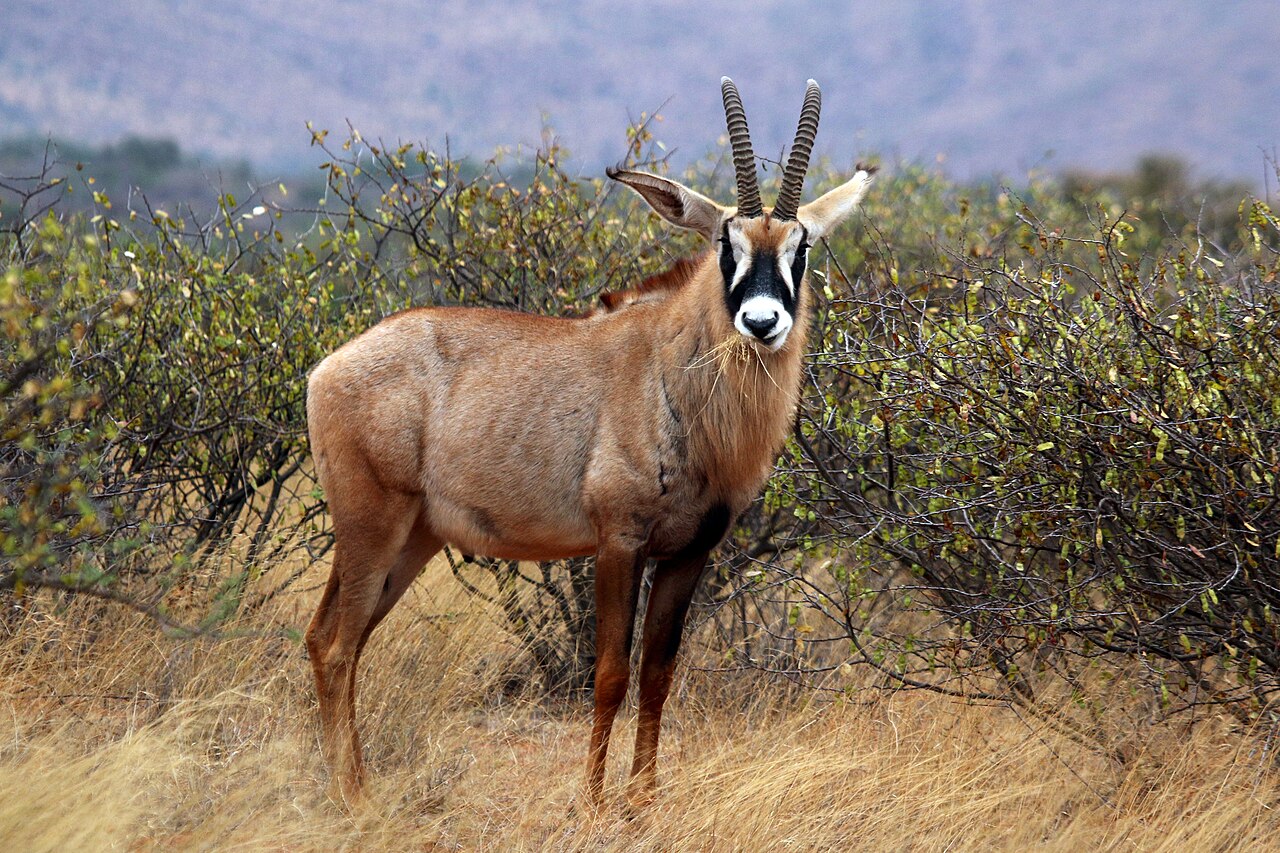
Ruma is often described as the "Last Retreat of the Roan Antelope." The roan is one of Africa's largest antelopes, standing well over a metre at the shoulder, with a horse-like build, distinctive black-and-white facial markings, tufted ears and backward-curving horns. Across much of its former range the species has declined steeply, and in Kenya the indigenous population is now confined almost entirely to Ruma. Conservation assessments have placed the resident population in critical condition, with numbers estimated at only a few dozen individuals in recent years, making the park's management a matter of national conservation significance.
The reasons for the roan's decline are instructive. Roan antelopes are sensitive to habitat change, competition from other grazers, disease and predation pressure on calves. The encroachment of dense bush into former open grassland, changes in fire regimes, and the historical impact of tsetse-control programmes all altered the valley's ecology. The Kenya Wildlife Service has experimented with grassland management, predator monitoring and habitat manipulation to give the small herd the best chance of recovery, but the population remains fragile and is closely watched by ecologists.
Other Wildlife
While the roan is the flagship, Ruma supports a wider community of mammals. The park is home to the Rothschild's giraffe, several of which were translocated to bolster regional populations, as well as Bohor reedbuck, oribi, Jackson's hartebeest, topi, impala, Defassa waterbuck, buffalo and the occasional leopard and hyena. Smaller species such as the serval cat, vervet monkey and various mongooses are present, and the riverine zones support hippo where water persists.
Birdlife is a particular draw. The park lies along important flyways and its grasslands and wetlands attract a rich avifauna, including the globally threatened blue swallow, which is a migrant visitor to the moist grasslands of the valley. Raptors, bustards, rollers and a variety of weavers and waterbirds make Ruma a rewarding destination for ornithologists, and its relatively low visitor numbers mean that birding can be done in solitude.
History and Gazettement
The protected area began life as the Lambwe Valley Game Reserve and was re-established as Ruma National Park in 1966, taking its name from a notable local figure associated with the area. The early decades of management were dominated by the twin challenges of tsetse fly control and the maintenance of the grassland habitats on which the roan depends. Over time, fencing of sections of the park was undertaken to reduce human-wildlife conflict with the surrounding farming communities of Suba and Lambwe, who cultivate maize, sorghum and other crops right up to the park boundary.
Conservation Challenges
Ruma illustrates many of the pressures facing small, isolated protected areas. Its modest size limits the genetic and demographic resilience of large-mammal populations, and the roan herd in particular is vulnerable to stochastic events such as disease outbreaks or a run of poor calf survival. Bush encroachment reduces the open grassland that grazers prefer, while the proximity of dense human settlement creates ongoing tension over crop raiding, grazing incursions and occasional poaching. Managing fire to maintain palatable grassland, controlling problem predators, and monitoring the health of the roan population are continuing priorities for the Kenya Wildlife Service, which manages the park as a national conservation asset. Detailed park information is maintained by the Kenya Wildlife Service, the state agency responsible for the country's parks and reserves.
Visiting Ruma
Ruma is one of Kenya's least-visited national parks, which is part of its appeal for travellers seeking solitude away from the crowded circuits of the Maasai Mara or Amboseli. The main access is by road from Kisumu through Homa Bay and Mbita, with the Kamato and Nyatoto gates serving as the principal entry points. The internal road network is basic and can become impassable during the long rains, so a high-clearance four-wheel-drive vehicle is strongly recommended, particularly between March and May.
Accommodation is modest and oriented towards self-catering and budget travellers. The Kenya Wildlife Service operates bandas and a guesthouse within or near the park, and camping is permitted at designated sites, offering an immersive experience in the quiet of the Lambwe Valley. Visitors should come prepared with supplies, as commercial services inside the park are limited. Park entry fees are set by the Kenya Wildlife Service and differ for citizens, residents and non-residents; current conservation fee schedules are published by the agency and through the national e-services platform at eCitizen.
Ruma in the Western Kenya Tourism Circuit
For the western Kenya tourism economy, Ruma is a potential anchor for a circuit that includes the Lake Victoria fishing communities, Mbita and Rusinga Island, Mfangano Island with its rock art, and the broader Homa Bay lakeshore. Diaspora investors and county tourism planners have long identified the under-developed western circuit as an opportunity, given that the bulk of Kenya's tourism revenue is concentrated in the south and on the coast. Improved roads, better marketing and investment in lodges around Homa Bay could position Ruma as a complement to lake-based tourism, generating income for surrounding communities and strengthening the economic case for protecting the roan.
The Broader Significance
Ruma National Park is, in many ways, a microcosm of conservation in a densely populated country. It demonstrates how a single protected area can carry national responsibility for an entire species, how habitat management decisions ripple through an ecosystem, and how the long-term survival of wildlife depends on reconciling the needs of neighbouring communities with those of the animals. The fate of the roan antelope in Kenya rests almost entirely on the success of management in this one valley. For visitors, conservationists and the people of Homa Bay alike, Ruma stands as both a reminder of fragility and a place of quiet, undervalued beauty in Kenya's far west.
More Articles

The Multiparty Era Reforms: Saba Saba, the Repeal of Section 2A and Kenya's Return to Political Pluralism
Jul 02, 2026

Eye Care in Kenya: Cataract, Trachoma and the Long Road to Universal Vision Health
Jul 02, 2026

Shaba National Reserve: Joy Adamson's Last Wilderness and Isiolo's Semi-Desert Safari Gem
Jul 02, 2026

The Rendille People of Northern Kenya: Camel Pastoralism, Clan Traditions and a Culture Under Pressure
Jul 02, 2026

Ukulima Sacco: From Ministry of Agriculture Staff Society to a National Cooperative Open to All Kenyans
Jul 02, 2026