Meru National Park: Rhino Sanctuary, Born Free Country and Kenya’s Wild Northern Frontier
Meru National Park: Rhino Sanctuary, Born Free Country and Kenya’s Wild Northern Frontier
Meru National Park occupies a remote and luxuriant corner of Kenya, lying to the northeast of the Mount Kenya massif and straddling the equator roughly 370 kilometres from Nairobi. Gazetted in 1966 and managed by the Kenya Wildlife Service, the park covers approximately 870 square kilometres of savannah, riverine forest, swamp and wooded grassland. It is a landscape defined by water: thirteen permanent rivers and a web of mountain-fed springs cross the park before draining into the Tana, Kenya’s longest river. This abundance of water gives Meru a verdant character that distinguishes it from the drier reserves further north, and it sustains a wildlife community that rewards the relatively few visitors who make the journey.
Geography and Landscape
The park sits in the transition zone between the cool highlands of the Mount Kenya foothills and the hot, semi-arid lowlands that stretch toward the Tana River basin. Altitude falls from around 900 metres in the west to roughly 300 metres in the east, producing a striking gradient of vegetation. Doum and raffia palms line the watercourses, dense riverine forest shelters the riverbanks, and open grassland and bushland dominate the interior. Volcanic soils in the west support tall grasses, while the eastern reaches are characterised by red lateritic earth that famously dusts the resident elephants a deep ochre.
Meru forms the core of a much larger conservation complex. Together with the adjoining Bisanadi, Mwingi, Kora and Rahole reserves, it anchors an ecosystem of more than 4,000 square kilometres, providing dispersal routes and dry-season refuge for wildlife across a vast and lightly settled region. The Tana and Rojewero rivers, fringed with palms and giant fig trees, give the park its lifeblood and form the boundary of much of the protected area.
The Rhino Sanctuary
One of Meru’s defining features is its dedicated rhino sanctuary, an extensively fenced and intensively guarded enclosure established near the main gate to shield the species from poaching. The sanctuary protects a healthy population of both black and white rhinoceros, with roughly 20 black rhinos and around 40 white rhinos under round-the-clock protection. The fenced design allows rangers to monitor each animal closely while maintaining a near-natural habitat, and the sanctuary has become an important breeding nucleus contributing to Kenya’s national rhino recovery programme.
Kenya’s rhino conservation strategy, coordinated by the Kenya Wildlife Service, aims to grow the national black rhino population steadily through secure sanctuaries and careful translocation between sites. Meru’s role in this effort reflects a broader national commitment to reversing the catastrophic declines of the 1970s and 1980s, when poaching reduced Kenya’s black rhino numbers from many thousands to only a few hundred. Detailed information on the country’s parks and species protection is published by the Kenya Wildlife Service.
Born Free and the Adamson Legacy
Meru is inseparable from one of the most famous conservation stories of the twentieth century. It was here that George and Joy Adamson raised Elsa, an orphaned lioness, and successfully returned her to the wild — a story immortalised in Joy Adamson’s book and the 1966 film Born Free. Elsa’s grave lies within the park and remains a place of pilgrimage for visitors drawn to the origins of the modern rewilding movement. The Adamsons’ work, and the global attention it attracted, helped to popularise the idea that individual wild animals and their habitats were worth protecting, an idea that underpins Kenya’s contemporary tourism economy.
A Cultural and Cinematic Landmark
The Born Free association continues to shape how Meru is marketed and understood. For many international travellers the park is “Elsa country,” a phrase that ties the physical landscape to a narrative of compassion and second chances. This heritage gives Meru a distinctive identity within Kenya’s circuit of protected areas and supports a steady, if modest, flow of high-value, low-volume tourism.
Wildlife
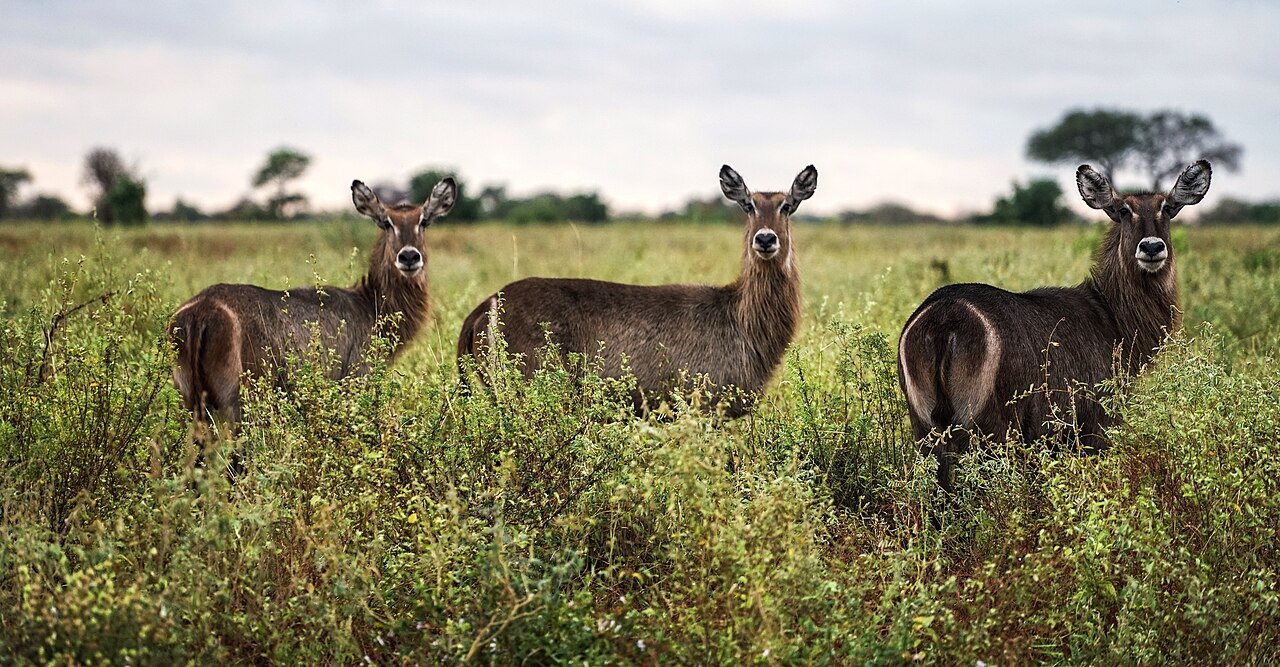
Despite its relatively low visitor numbers, Meru hosts an impressive diversity of species. The park is home to elephant, buffalo, hippopotamus, lion, leopard and cheetah, alongside a strong representation of northern Kenya’s dry-country specialists. Among the most sought-after sightings are the reticulated giraffe, the Grevy’s zebra, the long-necked gerenuk and the lesser kudu — species that are scarce or absent in the better-known southern parks. Hartebeest, waterbuck, oryx and Bohor reedbuck are also present in good numbers.
Birdlife is exceptionally rich, with several hundred recorded species drawn by the park’s rivers, swamps and varied vegetation. Palm-nut vultures, Pel’s fishing owls, kingfishers and a host of waterbirds frequent the riverine zones, while the open grasslands support bustards, rollers and birds of prey. The combination of permanent water and habitat variety makes Meru a rewarding destination for specialist wildlife watchers seeking species rarely encountered elsewhere.
Rivers, Swamps and Water Systems
Water is central to Meru’s ecology and to its appeal. The thirteen permanent rivers, fed by springs rising in the Nyambene Hills and the Mount Kenya highlands, guarantee year-round flow even during dry spells that parch surrounding districts. The Tana River, into which these waters eventually drain, is the longest river in Kenya and a critical national resource for hydroelectric power, irrigation and downstream communities. The health of the catchments feeding Meru therefore has significance well beyond the park’s boundaries, linking conservation here to national water and energy security. Catchment protection and water resource policy in Kenya are coordinated through agencies whose work is documented by the Ministry of Water.
Conservation Challenges and Recovery
Meru’s history is also a cautionary tale of conservation fortunes. During the 1980s the park suffered severely from poaching and insecurity, which decimated its rhino population and damaged its reputation among tour operators. A sustained programme of rehabilitation from the late 1990s onward — including reintroductions of elephant, rhino and other species, improved security, and infrastructure investment — restored Meru to its present condition. The recovery is widely cited as evidence that degraded protected areas can be brought back to ecological and commercial viability with adequate investment and political commitment.
Ongoing challenges include human-wildlife conflict on the park’s margins, the pressures of climate variability on water availability, and the need to ensure that tourism revenue translates into tangible benefits for neighbouring communities. Community conservancies and revenue-sharing arrangements are increasingly important in securing local support for conservation in the wider Meru landscape.
The Visitor Economy and Diaspora Relevance
Meru exemplifies a low-volume, high-value model of tourism that contrasts with the busier southern parks. Its remoteness limits visitor numbers but also preserves a sense of wilderness and exclusivity that appeals to discerning travellers, including members of the Kenyan diaspora seeking to reconnect with the country’s natural heritage. For diaspora investors, the broader Meru region offers opportunities in eco-lodges, conservancy partnerships and supporting services, while returning Kenyans and their families increasingly feature among domestic tourists supporting parks of this kind. National park entry fees and tourism policy, including conservation-fee structures that fund wildlife protection, are administered under frameworks set out by Kenya’s tourism and wildlife authorities.
Domestic and diaspora tourism also helps to diversify the visitor base beyond traditional international markets, building resilience against global shocks that periodically disrupt long-haul travel. Encouraging Kenyans at home and abroad to visit parks such as Meru strengthens the political and economic case for conservation while spreading the cultural value of these landscapes across generations.
Conclusion
Meru National Park distils much of what makes Kenya’s conservation story compelling: a dramatic and well-watered landscape, a rich and partly rare wildlife community, a fenced sanctuary safeguarding endangered rhinos, and a globally resonant heritage in the Born Free legacy. Its journey from near-collapse to recovery demonstrates both the fragility and the resilience of protected areas. For visitors willing to travel beyond the familiar circuits, and for a diaspora invested in the country’s future, Meru offers a quieter, deeper encounter with the Kenyan wild — one rooted in water, wildlife and the enduring idea that nature is worth setting free.
More Articles

The Multiparty Era Reforms: Saba Saba, the Repeal of Section 2A and Kenya's Return to Political Pluralism
Jul 02, 2026

Eye Care in Kenya: Cataract, Trachoma and the Long Road to Universal Vision Health
Jul 02, 2026

Shaba National Reserve: Joy Adamson's Last Wilderness and Isiolo's Semi-Desert Safari Gem
Jul 02, 2026

The Rendille People of Northern Kenya: Camel Pastoralism, Clan Traditions and a Culture Under Pressure
Jul 02, 2026

Ukulima Sacco: From Ministry of Agriculture Staff Society to a National Cooperative Open to All Kenyans
Jul 02, 2026