Mount Elgon National Park: Kitum Cave, Elephants and Kenya's Second-Highest Mountain
Mount Elgon National Park: Kitum Cave, Elephants and Kenya's Second-Highest Mountain
Mount Elgon National Park protects the Kenyan slopes of one of East Africa's oldest and largest extinct volcanoes. Rising on the border between Kenya and Uganda, Mount Elgon is the second-highest mountain in Kenya after Mount Kenya, and its vast, eroded caldera, ancient lava caves and rich montane forests make it one of the most distinctive protected landscapes in the country. The park is celebrated above all for two things: the famous cave-dwelling, salt-mining elephants of Kitum Cave, and the dramatic scenery of a mountain whose base is one of the broadest of any free-standing volcano in the world.
Geology and Geography
Mount Elgon is a solitary shield volcano whose activity ceased several million years ago. Over time, erosion has carved its once-towering cone into a rugged massif crowned by a caldera roughly eight kilometres across, rimmed by a series of jagged peaks. On the Kenyan side, the highest point is Koitobos, a flat-topped basalt peak; the mountain's overall summit, Wagagai, lies across the border in Uganda. The mountain's enormous base spans a huge area, and its lower and middle slopes are cloaked in dense forest that gives way to bamboo zones, heath and, near the top, the otherworldly Afro-alpine moorland studded with giant groundsels and lobelias.
The national park lies largely within Trans Nzoia County, with the main Chorlim Gate situated about 15 kilometres from the agricultural town of Kitale. The entire transboundary mountain is managed jointly by two agencies, the Kenya Wildlife Service on the Kenyan side and the Uganda Wildlife Authority on the Ugandan side, reflecting the way the protected area straddles the international frontier.
The Salt-Mining Elephants and Kitum Cave
The most famous feature of Mount Elgon is its population of cave-going elephants, sometimes dubbed the "troglodyte tuskers." These are savannah elephants (Loxodonta africana) rather than the forest elephants of central Africa, and they have developed a remarkable behaviour: they venture deep into the mountain's lava caves at night to mine salt and minerals from the rock walls using their tusks. The most celebrated of these caverns is Kitum Cave, which penetrates around 200 metres into the mountainside, with a main chamber up to 100 metres wide. The grooves and scrape marks left by generations of elephants are clearly visible on the cave walls, a record of an underground foraging tradition found in very few places on earth.
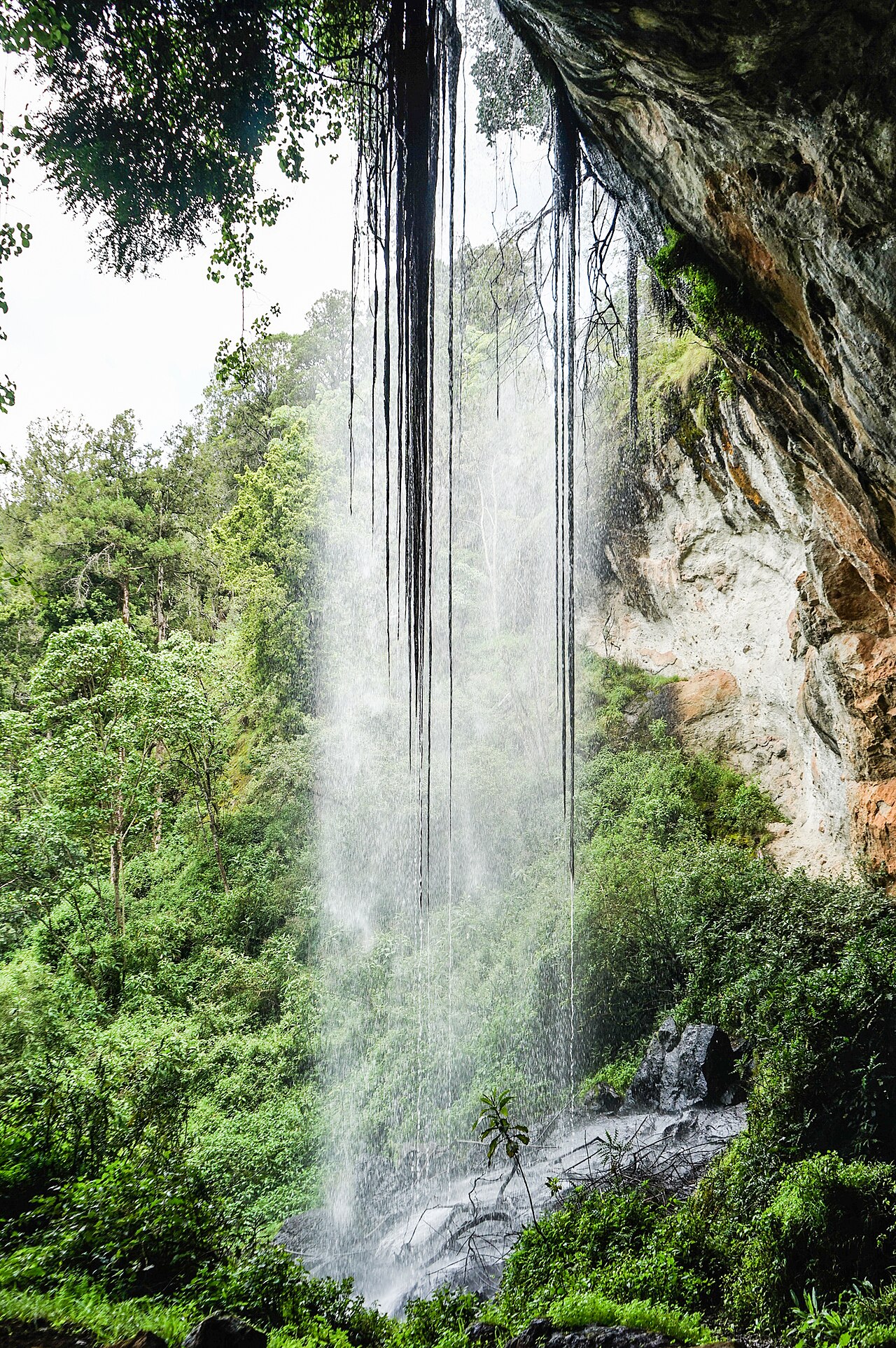
The elephant population on the mountain, numbering roughly one hundred individuals, was severely reduced by ivory poaching during the 1980s and 1990s and remains a focus of protection efforts. Other notable caves on the mountain include Makingeny, with its waterfall at the entrance, and Chepnyalil. The combination of cave geology and large mammal behaviour gives Mount Elgon a scientific interest matched by few protected areas anywhere.
Wildlife and Birds
Beyond the elephants, Mount Elgon supports buffalo, bushbuck, duiker, the giant forest hog, defassa waterbuck and a variety of primates including black-and-white colobus, blue monkeys and the occasional De Brazza's monkey in riverine forest. Leopard and spotted hyena are present but elusive. The mountain's range of altitudes, from forest through bamboo to moorland, creates a mosaic of habitats that supports high biodiversity and makes each zone of the ascent ecologically distinct.
For birdwatchers, Mount Elgon is an important site, with more than three hundred recorded species. The rare Jackson's francolin, highland forest specials, turacos, the lammergeier or bearded vulture soaring over the cliffs, and a host of sunbirds reward patient observers. The mountain is recognised as an Important Bird Area, underlining its significance for conservation and its appeal to the growing community of birding tourists in western Kenya.
A Critical Water Tower
Mount Elgon is one of Kenya's five major "water towers," the forested highland catchments that capture rainfall and feed the country's rivers. The mountain's forests are the source of the Nzoia, Turkwel and other rivers that sustain agriculture and communities across western Kenya and feed both the Lake Victoria and Lake Turkana systems. Protecting the forest cover of Elgon is therefore not only a matter of biodiversity but of water security for millions of people downstream. The catchment importance of the mountain is recognised in national environmental policy, and the forest reserves on the lower slopes are managed by the Kenya Forest Service alongside the national park.
Hiking and Tourism
Mount Elgon offers some of the most rewarding and least-crowded mountain trekking in Kenya. Unlike Mount Kenya, its rounded profile means the ascent to the caldera rim and the Koitobos peak is more of a strenuous hike than a technical climb, accessible to reasonably fit walkers accompanied by rangers. Routes typically begin from the Chorlim or Kimothon gates and pass through forest and bamboo into the moorland, with highlights including the hot springs within the caldera, Endebess Bluff and panoramic viewpoints over the surrounding plains.
The park is well suited to a multi-day camping or trekking expedition, with campsites and modest self-catering accommodation available, and day visits focused on the caves and forest are popular with travellers based in Kitale. Game drives on the lower slopes, guided cave visits and birding walks round out the experience. Park entry fees are determined by the Kenya Wildlife Service and vary for citizens, residents and non-residents, with current rates and bookings available through the national services portal at eCitizen.
Conservation and Community
The forests of Mount Elgon face pressure from encroachment, illegal logging, charcoal production and grazing, and the management of the protected area must balance conservation with the needs of the densely settled farming communities of Trans Nzoia and Bungoma counties. Community forest associations, participatory forest management and ecotourism revenue-sharing are among the tools used to align local livelihoods with the long-term protection of the mountain. Historical land disputes around the mountain's slopes, including those affecting communities such as the Ogiek and Sabaot, have made governance of the forest a sensitive and important issue that continues to shape conservation policy.
Why Mount Elgon Deserves Attention
Mount Elgon combines geological grandeur, a singular wildlife spectacle in its cave-mining elephants, exceptional birdlife and critical ecological services as a water tower. For the western Kenya tourism circuit it is an underrated jewel, offering an experience quite different from the savannah parks for which Kenya is best known. For conservationists and the communities that depend on its rivers, it is a landscape whose protection carries consequences far beyond its boundaries. A visit rewards travellers with quiet forests, dramatic high-altitude scenery and the chance to stand in a cave shaped by elephants over thousands of years.
More Articles

The Multiparty Era Reforms: Saba Saba, the Repeal of Section 2A and Kenya's Return to Political Pluralism
Jul 02, 2026

Eye Care in Kenya: Cataract, Trachoma and the Long Road to Universal Vision Health
Jul 02, 2026

Shaba National Reserve: Joy Adamson's Last Wilderness and Isiolo's Semi-Desert Safari Gem
Jul 02, 2026

The Rendille People of Northern Kenya: Camel Pastoralism, Clan Traditions and a Culture Under Pressure
Jul 02, 2026

Ukulima Sacco: From Ministry of Agriculture Staff Society to a National Cooperative Open to All Kenyans
Jul 02, 2026