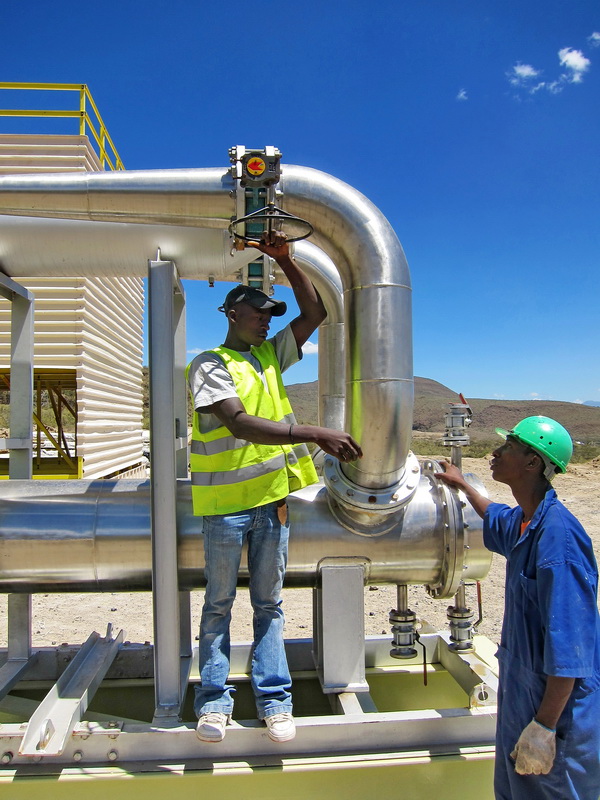
Kenya's 90% Renewable Grid: A 2026 Diaspora Investor Guide to Geothermal, Wind, Solar and the Carbon-Credit Opportunity
Kenya's 90% Renewable Grid: A 2026 Diaspora Investor Guide to Geothermal, Wind, Solar and the Carbon-Credit Opportunity
Kenya quietly became one of the greenest electrified economies in the world. In 2025, the country generated 15,067 GWh of electricity, with more than 90 per cent of it from renewable sources. Geothermal power from the Olkaria fields supplied roughly 47 per cent of the grid. Hydro, despite drought-year variability, delivered about 28 per cent. Wind from the Lake Turkana Wind Power project and a smaller cluster around Ngong Hills contributed 13 per cent. Solar, both grid-tied and distributed, made up the balance with biomass and a small thermal back-stop. For diaspora investors, this is not a fact to admire from a distance. It is the foundation of a multi-billion-dollar investment thesis that ranges from utility-scale projects to small distributed solar to the emerging carbon-credit market under Article 6 of the Paris Agreement.
This article walks through the energy mix, the regulatory framework, the financing vehicles that diaspora investors can actually access, and the practical opportunities that have surfaced in 2026.
The Energy Mix in Plain Numbers
The Kenya Electricity Generating Company (KenGen), the publicly listed state utility, owns most of the geothermal and hydro assets. Independent Power Producers (IPPs) own the bulk of the wind and a significant share of small-hydro. Kenya Power and Lighting Company (KPLC), also publicly listed, owns transmission and distribution. The Kenya Electricity Transmission Company (KETRACO) handles high-voltage backbone lines. The Rural Electrification and Renewable Energy Corporation (REREC) handles off-grid extension.
The most important number for diaspora investors is that effective electricity tariffs in Kenya remain among the more expensive in Africa for commercial users — averaging USD 0.18-0.20 per kWh for medium-voltage customers — despite the renewable mix. The gap between low generation cost and high retail tariff is mostly explained by transmission losses, foreign-currency-denominated PPA obligations, and legacy thermal contracts that the system is steadily unwinding. The implication is that distributed solar with battery storage for commercial and industrial users is increasingly competitive on a levelised-cost-of-electricity basis.
Geothermal: Kenya's Crown Jewel
The Olkaria geothermal fields in the Rift Valley produce around 950 MW from a string of plants — Olkaria I, II, IV, V, and the Olkaria I Additional Units. Menengai near Nakuru is expanding through a build-own-operate framework. Eburru, Suswa, and Longonot are the next-frontier sites. Geothermal is the most reliable renewable in the mix because it does not depend on weather or river flow. For diaspora investors, direct equity investment in geothermal is not generally available — it is dominated by KenGen and licensed IPPs — but indirect exposure through the Nairobi Securities Exchange (KenGen, KPLC) and through green bonds issued by financial intermediaries is accessible.
Wind: Turkana and Beyond
Lake Turkana Wind Power, with 365 turbines and a 310 MW capacity, has been operational since 2018 and remains the largest single wind farm in Africa. A second-phase expansion has been approved subject to grid upgrades by KETRACO. Smaller wind projects are progressing around Marsabit, Ngong, and along the coast. For diaspora investors, wind project ownership stakes are typically reserved for large institutional players, but the supply chain — civil works, blade logistics, O&M, and community engagement contracts — has been a productive entry point for diaspora-led services firms.
Solar: The Distributed Opportunity
Utility-scale solar in Kenya has grown more slowly than wind because of grid integration constraints and the wealth of cheap geothermal baseload. Where solar has exploded is in distributed commercial-and-industrial deployments. Hotels, factories, schools, hospitals, and commercial buildings now routinely instal rooftop solar with battery storage and grid hybridisation. The Energy Act 2019 and the Net Metering Regulations 2022 created a clear framework for excess-energy injection into the grid, which makes the business case stronger.
For diaspora investors, distributed solar is the most accessible play. A diaspora-funded EPC (engineering, procurement, and construction) firm or a power-purchase-agreement (PPA) financing vehicle can earn IRRs of 15-25 per cent on portfolios of well-screened C&I projects. The Kenya Renewable Energy Association (KEREA) maintains a directory of licensed installers and references.
Off-Grid and Mini-Grids
Kenya is a global leader in off-grid solar home systems, with M-KOPA, d.light, and a dozen smaller players serving more than five million households. Mini-grids serve fishing villages, refugee settlements, and remote markets. The Kenya Off-Grid Solar Access Project (KOSAP), funded by the World Bank, has anchored mini-grid roll-out in the fourteen counties with the lowest electrification rates. For diaspora investors with social-impact mandates, the mini-grid sector offers blended-finance returns of 8-12 per cent with meaningful poverty-alleviation impact.
Carbon Credits and the Article 6 Opportunity
The Climate Change (Amendment) Act 2023 and the Kenya Carbon Markets Regulations 2024 set the legal architecture for carbon credit generation and sale. Kenya has positioned itself as one of the first African jurisdictions ready to participate in Article 6 transactions under the Paris Agreement. Geothermal, reforestation, agro-forestry, clean-cookstove, and grid-emission-avoided projects all qualify under verified methodologies. The Carbon Standards Authority of Kenya — set up under the National Environment Management Authority — accredits verifiers and issues registry numbers.
For diaspora investors, the carbon credit market is the highest-uncertainty, highest-upside angle of the energy story. Project developers raise capital against expected credit issuance, sell credits to corporate buyers in Europe and the US, and share revenue with land-owning communities. Successful projects in Kenya have delivered USD 5-25 per tCO2e to investors. The pitfalls are real: registry uncertainty, methodology revision risk, and community consent disputes have killed several large projects. Diaspora investors should engage only through experienced developers and ideally only via blended-finance structures that include a development finance partner.
Green Bonds and Listed Equity
The Nairobi Securities Exchange has hosted three green bond issuances since 2019, including the Acorn Holdings green bond financing student housing with renewable-powered buildings. The NSE Green Bond segment is supported by Climate Bonds Initiative certification. Diaspora investors can buy NSE-listed green bonds through any CMA-licensed stockbroker. Yields have ranged from 11 to 14 per cent in shilling-denominated paper.
On the equity side, KenGen and KPLC remain the cleanest pure-play exposures to the energy transition. KenGen is a major dividend payer with a relatively predictable cash flow underpinned by long-tenor PPAs. KPLC is structurally challenged by debt and tariff politics but trades at deep discounts to historical earnings.
Regulatory Framework Diaspora Investors Should Read
The Energy Act 2019 is the foundation. The Net Metering Regulations 2022 govern small-scale renewables. The Energy and Petroleum Regulatory Authority (EPRA) handles licences. The Energy and Petroleum Tribunal handles disputes. The Climate Change Act 2016 and its 2023 amendment govern carbon markets. The Public Private Partnerships Act 2021 governs large-scale project structuring.
The EPRA portal publishes licences, gazetted tariffs, and complaints data. The KenGen investor relations portal publishes the operational and financial information needed for the listed equity thesis.
What Diaspora Energy Investors Should Do This Quarter
First, decide your risk profile. Listed equity and green bonds are the lowest-friction entry points. Distributed solar PPAs are mid-risk, mid-return. Mini-grids and carbon-credit project equity are highest-risk, highest-return. Second, engage a CMA-licensed advisor for any listed-market investment. Third, for project equity, partner with at least one development finance institution to share due diligence cost. Fourth, attend the annual Africa Energy Forum and the Kenya Geothermal Conference to build the relationships that turn high-quality opportunities into actual deals.
The Bigger Picture
Kenya's 90 per cent renewable grid is not just an environmental headline. It is the basis of a real industrial advantage in data centres, electric mobility, green manufacturing, and carbon-credit generation. The capital that flowed into Kenya's tech sector over the last decade was an early-mover bet. The capital that flows into Kenyan green industry over the next decade is the next equivalent bet. Diaspora Kenyans, who can deploy patient capital with a longer horizon than most institutional investors, are uniquely positioned to participate in this transition. The companion piece on the 2026 Economic Survey documents how energy is now a real comparative advantage; this article shows how to act on it.
More Articles

The Multiparty Era Reforms: Saba Saba, the Repeal of Section 2A and Kenya's Return to Political Pluralism
Jul 02, 2026
Eye Care in Kenya: Cataract, Trachoma and the Long Road to Universal Vision Health
Jul 02, 2026
Shaba National Reserve: Joy Adamson's Last Wilderness and Isiolo's Semi-Desert Safari Gem
Jul 02, 2026
The Rendille People of Northern Kenya: Camel Pastoralism, Clan Traditions and a Culture Under Pressure
Jul 02, 2026
Ukulima Sacco: From Ministry of Agriculture Staff Society to a National Cooperative Open to All Kenyans
Jul 02, 2026