Karatina Market: East Africa's Largest Open-Air Market and the Engine of Mount Kenya's Farm Trade
Karatina Market: East Africa's Largest Open-Air Market and the Engine of Mount Kenya's Farm Trade
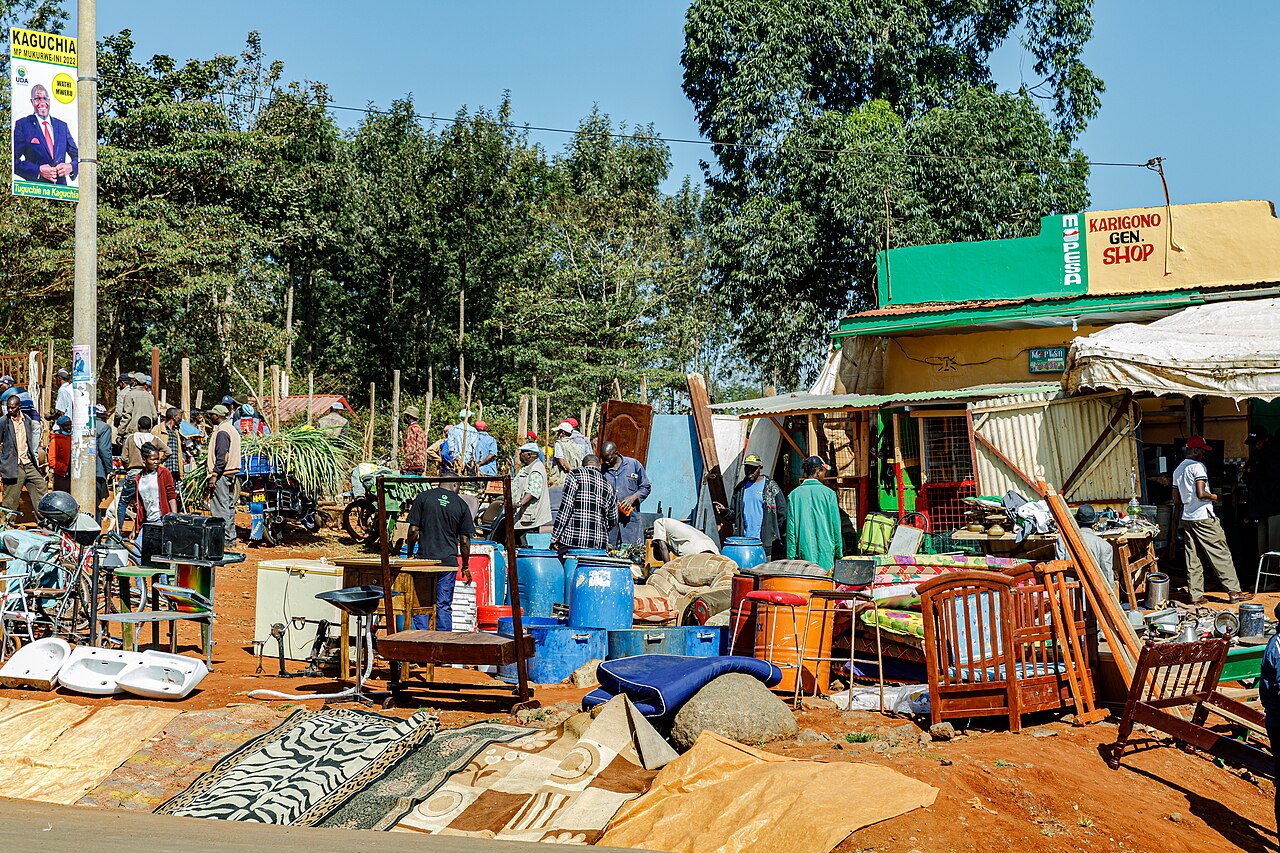
Roughly 130 kilometres north of Nairobi, along the busy Nairobi–Nyeri highway, sits a town whose name is synonymous with trade across central Kenya. Karatina, in Nyeri County, hosts what is widely described as the largest open-air market in East and Central Africa, and by some accounts the second largest on the continent after Kano in Nigeria. Every market day the town's population swells as farmers, brokers, transporters and retail traders converge on the market to move fresh produce from the fertile slopes of Mount Kenya and the Aberdare Range to consumers across the country.
The market is more than a trading venue. It is a price-setting institution for the region's horticulture, a source of livelihoods for thousands of households, and a case study in how county governments and the national government have tried to modernise market infrastructure without disrupting the informal trading systems that make such markets work.
From Barter Centre to Regional Powerhouse
Karatina's trading history stretches back to 1938, when the site began operating as a barter trade centre serving communities on the southern slopes of Mount Kenya. Its location proved strategic. The construction of the Nairobi–Nanyuki railway line passed through the town and gave farm produce from the region a direct route to Nairobi and beyond, accelerating the market's growth through the 1940s and 1950s. Local tradition holds that early trade took place under a large muratina tree, from which the town's name is said to derive.
After independence, Karatina consolidated its position as the collection and redistribution point for produce grown across Nyeri, Kirinyaga, Murang'a and parts of Meru and Embu. Smallholder farmers, most cultivating plots of under an acre, brought potatoes, cabbages, tomatoes, bananas, maize and beans to the market, where wholesale buyers consolidated loads for Nairobi's Wakulima Market, Mombasa and towns across the Rift Valley. That basic architecture of trade persists today, and it is one reason the market has remained resilient through decades of economic change.
The Modern Market: A Three-Storey Trading Hub
For most of its history Karatina Market operated as a sprawling open-air ground, exposed to weather and chronically short of storage, sanitation and drainage. That began to change in the late 2010s, when the national government and the County Government of Nyeri invested in a modern three-storey market complex, officially opened in 2019. County authorities reported that more than 2,000 traders were allocated space in the new building, which provides covered stalls, cold storage, banking halls, sanitation facilities and dedicated loading areas.
The redevelopment was part of a broader national programme of market modernisation intended to improve hygiene, reduce post-harvest losses and widen the revenue base of county governments, which collect fees from traders. For Nyeri County, market fees from Karatina represent a significant own-source revenue stream, and the county has paired the infrastructure with cess collection points along produce routes.
What Is Traded
Karatina is known above all for fresh food. Potatoes and cabbages from the high-altitude zones of Kieni and Nyandarua, bananas from Kirinyaga and Meru, tomatoes and onions from Karatina's immediate hinterland, and cereals and pulses from further afield all move through the market. Alongside fresh produce, the market trades in cereals, livestock feed, second-hand clothing, household goods and crafts, including the sisal baskets known as ciondo that central Kenya's women's groups have woven for generations.
Market Days and Rhythm
Trading peaks on designated market days, when open-air sections fill with sellers who travel from surrounding sub-counties. Activity begins before dawn, when wholesale buyers negotiate directly with farmers and brokers over lorry-loads of produce. By mid-morning the wholesale trade gives way to retail, and by late afternoon the market winds down as transporters depart for Nairobi. This daily and weekly rhythm sets reference prices that farmers across the Mount Kenya region use to time their harvests and negotiate at the farm gate.
The Market's Economic Significance
Agriculture remains the backbone of Nyeri County's economy, and the county's development plans consistently identify trade and agro-processing as priority sectors. National statistics underline how much is at stake. The Kenya National Bureau of Statistics reports that agriculture contributes about a fifth of Kenya's gross domestic product directly, with wholesale and retail trade among the largest employers in the informal sector. Markets like Karatina sit at the junction of those two sectors: they are where farm output becomes traded value and where informal employment concentrates.
Studies of smallholder market access in central Kenya have repeatedly found that proximity to a major open-air market improves farm-gate prices and encourages farmers to diversify into higher-value horticulture. Development organisations working in the region have documented how commercial villages and farmer groups organise collective deliveries to Karatina to gain bargaining power against brokers. For thousands of smallholders, the market is effectively their route into the cash economy.
Employment Beyond the Stall
The market's employment footprint extends well beyond the traders who occupy stalls. Porters, cart operators, loaders, food vendors, boda boda riders, matatu crews and lorry drivers all earn their living from the daily movement of produce. Financial institutions, mobile money agents and savings groups cluster around the market to serve traders, and Karatina town's hospitality sector, from eateries to lodgings, depends heavily on market traffic.
Challenges Facing Karatina Market
The market's scale brings persistent challenges. Traders have at times resisted relocation into the modern complex, arguing that upper-floor stalls attract less customer traffic than the open ground, a pattern seen in market modernisation projects across Kenya. Congestion on market days strains the town's roads and sanitation systems. Post-harvest losses remain high for perishables when supply gluts coincide with transport bottlenecks, and price volatility exposes both farmers and traders to sudden losses.
Climate variability adds further pressure. The rain-fed farming systems that feed the market are increasingly exposed to erratic rainfall, and county agricultural officers have promoted irrigation and drought-tolerant varieties among supplying farmers. Meanwhile, competition from supermarket supply chains and aggregators purchasing directly at the farm gate is slowly changing the wholesale trade, although open-air markets still handle the overwhelming majority of Kenya's domestic fresh produce.
Visiting and Trading at Karatina
Karatina is easily reached by road from Nairobi via Thika and Sagana, a journey of roughly two hours outside peak traffic, and the town retains a station on the railway line to Nanyuki. Traders seeking stalls apply through the county's trade department, which administers allocations and collects the daily fees that fund market services. For visitors, the market offers one of the most vivid views of Kenya's agricultural economy at work: the volumes moving through Karatina on a single peak day illustrate why central Kenya is often called the country's food basket.
Agencies such as the Ministry of Agriculture and Livestock Development publish market price bulletins that include reference prices from major markets, and these are widely used by farmers deciding when and where to sell. The Agriculture and Food Authority also regulates cess and produce movement, decisions which directly affect the cost of trading through hubs like Karatina.
Why Karatina Matters
Kenya's food system is often described through its export crops, but the domestic trade in staples and vegetables is far larger in volume and touches far more livelihoods. Karatina Market concentrates that domestic trade in a single place. Its history, from a barter centre under a muratina tree to a three-storey complex serving thousands of traders, tracks the broader story of Kenya's rural economy: growing commercialisation, persistent informality, and infrastructure trying to catch up with trade that never stopped moving.
For farmers on the slopes of Mount Kenya, the market remains the surest answer to the question that follows every harvest: where will this crop find a buyer? For nearly nine decades, the answer has been Karatina.
More Articles

The Multiparty Era Reforms: Saba Saba, the Repeal of Section 2A and Kenya's Return to Political Pluralism
Jul 02, 2026

Eye Care in Kenya: Cataract, Trachoma and the Long Road to Universal Vision Health
Jul 02, 2026

Shaba National Reserve: Joy Adamson's Last Wilderness and Isiolo's Semi-Desert Safari Gem
Jul 02, 2026

The Rendille People of Northern Kenya: Camel Pastoralism, Clan Traditions and a Culture Under Pressure
Jul 02, 2026

Ukulima Sacco: From Ministry of Agriculture Staff Society to a National Cooperative Open to All Kenyans
Jul 02, 2026