Hell's Gate National Park Explained: Kenya's Walking-Safari Volcanic Wonderland, the Geothermal Industry and the Lake Naivasha Hinterland
Hell's Gate National Park Explained: Kenya's Walking-Safari Volcanic Wonderland, the Geothermal Industry and the Lake Naivasha Hinterland
Hell's Gate National Park, in Nakuru County south of Lake Naivasha, is one of Kenya's most distinctive National Parks. Covering only 68.25 square kilometres — substantially smaller than most other Kenyan Parks — Hell's Gate is unique in allowing visitors to walk and cycle freely through the Park, an experience unavailable in most Kenyan wildlife reserves where vehicle-based game drives are mandatory. The Park's dramatic volcanic landscape — including the Fischer's Tower and Central Tower volcanic plugs, the Hell's Gate Gorge with its steam-vent walls and hot springs, the dramatic cliffs and the broader Rift Valley geology — together create one of the most photographically distinctive Kenyan Parks. The Park lies in the geothermal-active region surrounding the Olkaria geothermal field, where KenGen operates one of Africa's largest geothermal power complexes producing approximately 950 MW of clean electricity. The Park has appeared in international film productions including the 1994 Disney film "The Lion King" (the Pride Rock landscape inspired by the Hell's Gate cliffs) and the 2003 film "Tomb Raider: The Cradle of Life." This guide walks through the Park geography, the wildlife (more sparse than the major Parks but with distinctive species), the walking and cycling activities, the Olkaria geothermal complex, the Lake Naivasha hinterland connection, and the practical considerations for visitors.
The Park Geography
Hell's Gate sits in the Rift Valley floor south of Lake Naivasha. The Park's central feature is the Hell's Gate Gorge — a narrow canyon with steep cliffs, hot springs, and steam vents from the underlying geothermal activity. The Fischer's Tower (a 25-metre volcanic plug at the Park's northern entrance) and the Central Tower (the larger volcanic plug in the Park interior) are the most photographed features. The Park's southern boundary borders the Olkaria geothermal field, with steam plumes from the geothermal infrastructure visible from selected viewpoints. The Park's western boundary borders the Ol Karia volcano area.
Walking and Cycling
The unusual freedom to walk and cycle through Hell's Gate is the principal visitor draw. The Park has limited large dangerous wildlife (no lions, very few elephants, no buffalo in the principal visited zones), allowing the walking-safari approach that is restricted in the Big-Five Parks. Visitors typically cycle through the Park (bicycles available for hire at the gate), walk the Hell's Gate Gorge trail, and visit the hot springs and steam vents that punctuate the gorge floor. Guided gorge walks are recommended particularly during the wet seasons when flash flooding from the surrounding catchments can affect the gorge floor.
Wildlife
Hell's Gate's wildlife community, while not on the scale of the major Parks, includes zebra (the most commonly seen species), giraffe, hartebeest, eland, Thomson's gazelle, Grant's gazelle, baboons, klipspringer (on the cliff faces), and the broader savannah herbivore community. The Park hosts important populations of cliff-nesting raptors including Verreaux's Eagle, Augur Buzzard, and the Ruppell's Vulture. The geothermal-influenced thermal springs in the gorge support distinctive microbial communities and warm-water-adapted small fauna.
The Olkaria Geothermal Complex
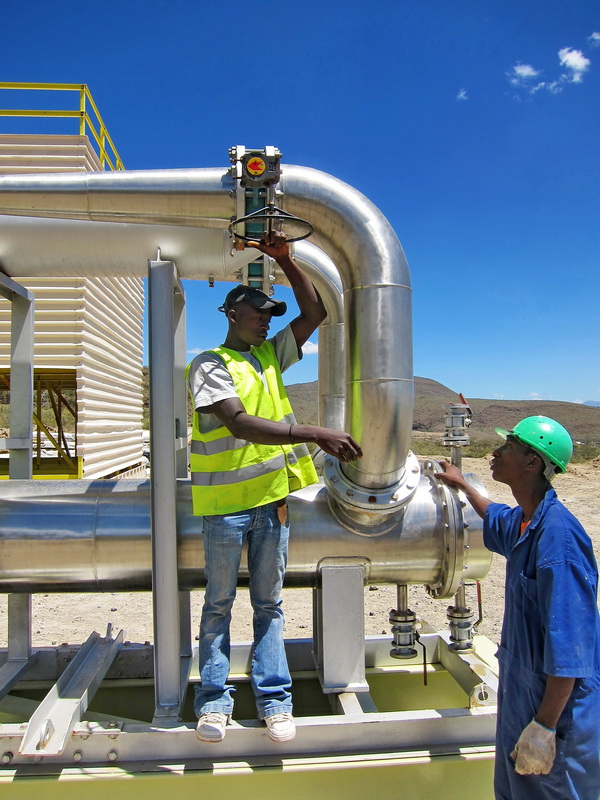
The Olkaria geothermal complex on the Park's southern boundary is one of Africa's largest geothermal energy operations. KenGen's Olkaria I, II, IV, and V plants, together with the Olkaria I Additional Units, generate approximately 950 MW of clean electricity from the geothermal resource — almost half of Kenya's grid demand. The Olkaria Geothermal SPA at the Olkaria-side of the Park boundary offers visitors the experience of bathing in geothermally-heated mineral water in pools that are uniquely Kenyan among the country's tourism attractions. The geothermal industry has been the focus of substantial international interest as Kenya's renewable-energy model has gained global attention.
Lake Naivasha Hinterland
Lake Naivasha — the freshwater Rift Valley lake immediately north of Hell's Gate — is a major Kenyan tourism and economic centre in its own right. The lake hosts substantial cut-flower farms (the principal export-horticulture industry of Kenya is concentrated around Naivasha, producing thousands of tonnes of roses, carnations, and other cut flowers annually for the European auction market), hippo populations, the Crescent Island wildlife sanctuary, the Elsamere conservation centre (the historical home of Joy Adamson, author of "Born Free"), and a developed tourism infrastructure including hotels, lodges, and the broader hospitality and recreation services. The combination of Hell's Gate Park, the Lake Naivasha shoreline, and the broader Naivasha hinterland produces one of the most popular multi-day tourism circuits in Kenya, particularly for visitors based in Nairobi seeking an accessible weekend safari experience.
The Standard Gauge Railway and the Naivasha Inland Container Depot
The Standard Gauge Railway from Mombasa terminates at the Naivasha Inland Container Depot (ICD), with the railway extending the broader logistics corridor into Kenya's interior. The Naivasha ICD has emerged as a meaningful logistics hub serving the broader trade flows. The combination of the geothermal industry, the cut-flower export industry, the SGR-anchored logistics, and the broader tourism economy makes the Naivasha region one of the most economically dynamic in Kenya.
Conservation and Tourism Management
KWS manages Hell's Gate National Park under the broader National Parks framework. The walking-safari and cycling activities require risk management given the inherent hazards of unsupervised access to active wildlife habitats, and KWS maintains the appropriate safety information and the guided-walk options for less experienced visitors. The Olkaria geothermal operations on the Park boundary are managed in coordination between KenGen, KWS, and the broader stakeholders, with the geothermal infrastructure substantially integrated with the broader Park landscape.
Visiting Hell's Gate
The Park is accessible from Nairobi by road (1.5-2 hours via the Mai Mahiu-Naivasha route or the Limuru-Naivasha route). The Park is ideal for day visits combined with the broader Naivasha hinterland — typically a morning visit to the Park, an afternoon visit to Lake Naivasha (boat trip, Crescent Island), and an evening stay at one of the Naivasha lodges. Multi-day visits combining Hell's Gate, Lake Naivasha, the Mount Longonot National Park (the immediately neighbouring volcanic-crater Park), and the broader Rift Valley experience produce one of Kenya's most rewarding Nairobi-accessible itineraries. KWS publishes the Park fee schedule on its portal.
The Bigger Picture
Hell's Gate represents one of Kenya's most distinctive tourism experiences — the rare opportunity to walk and cycle through a wildlife area, set in dramatic volcanic landscape adjacent to one of Africa's largest geothermal energy complexes. The combination of natural, industrial, and cultural elements makes the Park a uniquely Kenyan experience that complements the broader Big Five safari circuit. For Nairobi-based visitors, returning diaspora seeking accessible safari experiences, school excursions and adventure tourists, Hell's Gate provides one of the most accessible and rewarding Kenyan park experiences.
The Kenya Wildlife Service manages the Park. The Kenya Electricity Generating Company operates the adjacent Olkaria geothermal complex.
More Articles

The Multiparty Era Reforms: Saba Saba, the Repeal of Section 2A and Kenya's Return to Political Pluralism
Jul 02, 2026

Eye Care in Kenya: Cataract, Trachoma and the Long Road to Universal Vision Health
Jul 02, 2026

Shaba National Reserve: Joy Adamson's Last Wilderness and Isiolo's Semi-Desert Safari Gem
Jul 02, 2026

The Rendille People of Northern Kenya: Camel Pastoralism, Clan Traditions and a Culture Under Pressure
Jul 02, 2026

Ukulima Sacco: From Ministry of Agriculture Staff Society to a National Cooperative Open to All Kenyans
Jul 02, 2026